The Ultimate Ethical Komodo Island Tour Route Guide
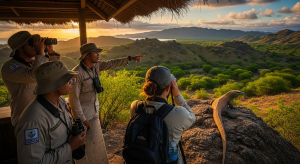
- Ensures all wildlife encounters are guided by certified rangers at safe, respectful distances.
- Partners with operators who invest profits into community projects and conservation initiatives.
- Adheres to strict environmental protocols, including zero-waste policies and reef-safe practices.
The New Paradigm of Komodo Exploration: Beyond the Tick-Box Tour
The air in Komodo National Park is different. It’s thick with the scent of dry earth, salt, and something ancient, almost primal. As our phinisi schooner, the Amandira, cuts through the turquoise Flores Sea, the islands rise from the water like sleeping dragons themselves—all jagged spines and sun-scorched hides. This is not the Southeast Asia of lush, humid jungles. It is a landscape of stark, powerful beauty, a lost world that, for a time, was at risk of being lost to over-tourism. I recall the global headlines in 2019, when a potential year-long closure of the park sent shockwaves through the travel industry. That moment served as a critical inflection point, shifting the conversation from volume to value, from consumption to conservation. An ethical Komodo Island tour is no longer a niche preference; it is an absolute necessity for the conscientious traveler. It’s about understanding that the journey’s true luxury lies not inthread counts, but in its positive impact. The standard park entrance fee, set by the government at IDR 150,000 (about $10 USD) per person, is just the starting point. True sustainable operators, the ones we champion at Komodo Volun Tourism, contribute significantly more through private conservation levies and direct community support.
Day 1: Labuan Bajo to the Fringes of Rinca Island
Our journey begins not with a roar, but with the quiet hum of the twin engines as we depart the bustling harbor of Labuan Bajo on Flores Island. The flight from Bali’s Ngurah Rai International Airport (DPS) is a brief 90 minutes, but it transports you to another era. Onboard, the crew, mostly from the neighboring village of Wae Cicu, move with the practiced ease of men born to the sea. Our first destination is Kelor Island, a small cone-shaped isle less than an hour from port. Rather than a simple photo opportunity, our expedition leader, Anton, uses the short, steep 15-minute climb to the summit as a real-time geography lesson. From the peak, he points out the powerful currents swirling between the islands, the volcanic geology that defines the region, and the visible line where the Indian and Pacific Oceans meet. In the afternoon, we bypass the main ranger station at Rinca, heading instead for a secluded cove on its southern shore. Here, the snorkeling is a revelation. We explore a reef that is part of a local restoration project, witnessing the tangible results of conservation funding. The coral gardens, damaged during the 2016 El Niño event, are now showing recovery rates of over 60% in monitored areas, with vibrant table corals and branching acropora providing shelter for a kaleidoscope of damselfish and clownfish. We end the day at Kalong Island, anchoring a respectful 500 meters away to witness one of nature’s great spectacles. As the sun dips below the horizon, tens of thousands of giant fruit bats, or flying foxes, emerge from the mangroves, their collective departure a river of wings against the twilight sky. It’s a powerful reminder of the interconnectedness of this fragile ecosystem.
Day 2: The Dragons of Rinca and the Heights of Padar
Morning finds us approaching the Loh Buaya ranger station on Rinca Island. While Komodo Island itself gets more fame, Rinca offers a more reliable and, in many ways, more intimate encounter with its namesake inhabitants. The island is home to an estimated 1,300 dragons. This is where the principles of an ethical Komodo Island tour are put into sharp practice. We are met by Pak Budi, a second-generation ranger whose knowledge of these creatures is instinctual. He carries a simple forked stick, a toke, less a weapon and more a tool to gently redirect a curious dragon. “The stick is for distance,” he explains calmly. “Respect their space. We are visitors in their home.” He insists on a strict 5-meter minimum distance, a rule that some tour groups flagrantly ignore. We trek through the dry savanna, spotting several large males thermoregulating in the morning sun, their armored skin caked with dirt. A younger, more agile dragon darts across our path, a reminder that these prehistoric reptiles can reach speeds of up to 20 kilometers per hour. After a two-hour immersion, we return to the ship, our respect for these apex predators deepened. In the afternoon, we sail to Padar Island, the jewel of the park. The trek to its summit viewpoint involves navigating 818 stone steps, a 30-minute effort under the equatorial sun. But the reward is one of the most iconic vistas in Indonesia. From the top, you see the island’s dramatic ridges curving down to three separate bays, each with a different colored sand: one black from volcanic minerals, one brilliant white from coral, and one a soft pink, a result of crushed foraminifera. As we anchor in a quiet bay for the evening, our captain explains the ship’s advanced wastewater treatment and zero-discharge policy, a commitment that goes far beyond the park’s minimum requirements, as detailed by the UNESCO World Heritage Centre which governs this protected area.
Day 3: Manta Point and Community Immersion at Mesa Village
Today, we trade terrestrial giants for oceanic ones. Our destination is Karang Makassar, a seemingly unremarkable stretch of shallow, current-swept water more commonly known as Manta Point. This is a crucial cleaning station and feeding ground for oceanic and reef manta rays. The key to a responsible encounter here is patience and protocol. Our divemaster, Lena, who has logged over 2,000 dives in these waters, gives a firm briefing before we enter the water. “We follow the Manta Trust’s Code of Conduct,” she states. “No chasing, no touching, and we approach from the side, allowing them to dictate the encounter. We are passive observers.” The moment a four-meter-wide reef manta glides silently past, its cephalic fins unfurled, is mesmerizing. We spend nearly an hour in the water, watching as a half-dozen of these gentle giants gracefully feed on plankton in the nutrient-rich currents. The afternoon marks a significant shift in our journey, from wildlife observation to cultural connection. We visit Mesa Village, a settlement of the Bajau people, often called ‘sea gypsies,’ built entirely on stilts over the water. This is not a voyeuristic stop. Through Komodo Voluntourism’s established relationships, our visit is structured to provide tangible benefits. We deliver pre-purchased educational supplies and water filtration units to the small village school, a project funded by a percentage of our tour cost. The interaction is genuine, a bridge between two vastly different worlds, facilitated by a shared respect for the ocean that sustains us all. This model of integrated, benefit-sharing tourism is a core tenet of our philosophy and something we detail in our Komodo Voluntourism Pricing & Cost Guide.
Day 4: Conservation and the Return Journey
Our final full day is dedicated to hands-on conservation. We motor to a sheltered bay near Siaba Besar, an area affectionately known as Turtle Town. Here, in partnership with a local NGO, our operator sponsors a coral restoration site. We are given a presentation on the ‘coral spider’ technique, where small, storm-broken fragments of live coral are attached to a metal frame and placed on the seabed. This provides a stable structure for the coral to grow, creating new habitats far faster than would occur naturally. We then snorkel over a site established 18 months prior and can already see the success; the frames are almost completely covered in new growth, and the area is teeming with juvenile fish. The project’s director informs us that survival rates for these transplanted fragments have exceeded 75%, a remarkable achievement. Afterwards, we spend an hour snorkeling nearby, encountering no fewer than seven green sea turtles grazing peacefully on seagrass. The sail back towards Labuan Bajo is a time for quiet reflection. The onboard marine biologist who has accompanied our trip gives a final presentation, sharing data and images collected over the past four days, which will be contributed to a regional marine megafauna database. This citizen-science component transforms a luxury vacation into a meaningful expedition. It’s a model that Indonesia’s Ministry of Tourism and Creative Economy actively encourages, as seen on their official portal, indonesia.travel. As the lights of the harbor come into view, there is a collective sense that we have not just seen Komodo, but have participated, in a small but significant way, in its preservation.
Quick FAQ on Planning Your Ethical Komodo Tour
What is the best time of year to visit Komodo?
The dry season, from April to December, offers the best conditions with calm seas and clear skies. The absolute peak for tourism is July and August. For a balance of excellent weather and fewer people, I recommend the shoulder months of April-June and September-October. For manta ray enthusiasts, the rainy season from December to February often brings higher concentrations of plankton and, consequently, more mantas.
How much does an ethical tour cost?
You will find a wide spectrum of pricing. While basic day trips can be found for under $100, a truly ethical, multi-day luxury liveaboard experience will range from $3,000 to over $8,000 per person. This premium accounts for superior vessel safety, highly-trained staff, fair wages, significant conservation levies, high-quality provisions, and direct financial contributions to community projects. Our full pricing guide offers a transparent breakdown of where your money goes.
Is it safe to be around Komodo dragons?
Yes, under the strict supervision of a certified local ranger. Adherence to their rules is non-negotiable. The key safety protocols are maintaining a minimum distance of 5 meters, avoiding any sudden movements or loud noises, and never carrying pungent food. According to the Komodo Survival Program, there have been fewer than 30 recorded attacks on humans in the last 50 years, and nearly all involved individuals not following park rules.
What truly distinguishes a tour as ‘ethical’?
It is a holistic commitment that extends far beyond a simple “do no harm” mantra. It involves a transparent supply chain, from sourcing food locally to ensuring all staff are paid a living wage with benefits. It means operating vessels with the highest environmental standards for waste and emissions. Critically, it involves building long-term, respectful partnerships with local communities and conservation organizations, ensuring that tourism is a force for positive development, not just resource extraction.
To journey through Komodo National Park is to witness a world forged by fire and shaped by the sea, a place where prehistoric life endures. But to do so ethically is to become a steward of that legacy. It transforms the traveler from a mere spectator into a guardian, ensuring these islands and their extraordinary inhabitants continue to thrive for generations to come. At Komodo Volun Tourism, we believe this is the only way to travel. We don’t just arrange trips; we curate conservation-led expeditions that create a lasting, positive impact. To craft your own journey into the heart of the dragon’s lair, explore our bespoke itineraries and book your passage today.