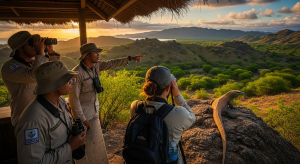
The Best Luxury Komodo Volunteer Programs for Eco-Conscious Couples
- Private Phinisi Yachts: Live aboard a fully-staffed traditional Indonesian schooner with modern amenities.
- Expert-Led Science: Work directly with marine biologists on critical reef and megafauna research.
- Bespoke Itineraries: Blend conservation work with private excursions, diving, and leisure.
The warm, saline air hangs heavy over the deck, carrying the scent of volcanic earth and clove from a distant island. Below, the turquoise water of the Flores Sea laps gently against the ironwood hull of your private phinisi schooner. A shadow, immense and graceful, glides beneath the surface—a reef manta, its five-meter wingspan a breathtaking welcome. This is not a passive vacation. This is an active immersion, a journey where the line between luxury and purpose dissolves into the rich, biodiverse waters of Komodo National Park. For the discerning couple, the question is no longer just “where to go,” but “what can we do,” and the answer lies here, the Coral Triangle.
Beyond the Infinity Pool: Redefining Luxury in the Lesser Sundas
For years, the definition of luxury travel was tethered to passive indulgence: thread counts, tasting menus, and impeccable, yet detached, service. Today, a new paradigm is taking hold, driven by a desire for connection, authenticity, and positive impact. The modern luxury traveler, particularly the eco-conscious couple, seeks not just to observe a destination but to participate in its preservation. This is the ethos at the core of the burgeoning komodo volun tourism movement. It’s an evolution from consumption to contribution, transforming a holiday into a legacy. Komodo National Park, a protected area encompassing 29 volcanic islands, is the perfect theater for this new form of travel. Designated a UNESCO World Heritage Site in 1991, its global significance cannot be overstated. The park’s total area of 1,733 square kilometers protects not only the world’s largest lizard, the Komodo dragon, but also a marine ecosystem of staggering richness. Engaging in a volunteer program here is not about roughing it; it’s about gaining privileged access. It’s the chance to see the park through the eyes of the scientists and conservationists working on the front lines, an experience far removed from the crowded day-trip boats departing from Labuan Bajo.
The Phinisi Experience: Your Private Floating Research Base
Forget cramped dormitories and basic field stations. The cornerstone of a luxury Komodo volunteer program is the accommodation: a magnificent, privately chartered phinisi yacht. These traditional two-masted Indonesian sailing ships, handcrafted for centuries by the Konjo people of South Sulawesi, have been reimagined as floating boutique hotels. A vessel like the Coral Guardian or the Varanus Explorer features three to five air-conditioned staterooms with en-suite bathrooms, a dedicated crew of 8-12 including a private chef, and expansive teak decks for dining, lounging, and stargazing. The onboard chef prepares gourmet meals using locally sourced ingredients, catering to any dietary preference, a far cry from standard expedition fare. This floating base provides mobility and exclusivity. While standard tourists are limited to a few popular sites, your phinisi can anchor in secluded bays and position you directly over critical research areas at dawn, long before other boats arrive. The yacht is equipped with modern dive gear, research equipment, and comfortable tenders for excursions, effectively serving as a state-of-the-art mobile marine laboratory. This level of comfort and logistical support allows you to focus entirely on the mission and the experience, ensuring you are rested and prepared for each day’s vital work.
The Work: Hands-On Conservation with Leading Marine Biologists
The “volunteer” component of these trips is a serious, structured, and deeply rewarding endeavor. Couples work alongside credentialed experts, contributing to long-term research projects. Activities are diverse and engaging. One morning might be spent on a research dive, meticulously photographing the pectoral fins of manta rays for identification, with the images later uploaded to a global database like MantaMatcher. The next day could involve deploying Baited Remote Underwater Video Systems (BRUVS) to survey shark populations in marine protected zones. A key focus is often coral reef restoration. Participants learn techniques to fragment healthy coral colonies and attach them to artificial reef structures in areas damaged by past dynamite fishing. The work is tangible; you leave knowing you have physically helped rebuild a section of reef. Beach surveys on uninhabited islands to collect and categorize plastic pollution provide critical data on marine debris patterns in the region. For those wanting a comprehensive overview of what these programs entail, The Definitive Komodo Voluntourism Guide offers a deeper the specific projects available.
Curated Itineraries: Blending Science with Serenity
A well-designed luxury volunteer program understands that the journey is as much about connection—with your partner and with nature—as it is about conservation. The itineraries are masterfully balanced to weave scientific work with moments of pure wonder and relaxation. A typical 7-day charter might begin with two days focused on manta ray research and coral gardening in the northern part of the park. Afternoons are reserved for data entry, yes, but also for kayaking through serene mangrove forests or simply relaxing on the sundeck as the yacht sails to its next anchorage. Mid-week, the focus might shift to terrestrial conservation, with a guided trek on Rinca Island. Led by an expert park ranger, you’ll track the legendary Komodo dragon (Varanus komodoensis), a creature that can weigh up to 70 kilograms and has existed for millions of years. This is followed by an evening of romance: a private dinner prepared by your chef on a deserted pink sand beach, the sand’s hue derived from microscopic red organisms called Foraminifera. The trip could conclude with exploratory dives in the south, known for its cooler, nutrient-rich waters and different marine life, before a final sunset sail back towards Labuan Bajo. This thoughtful blend ensures the experience is never grueling, but always enriching.
Vetting the Right Program: What Discerning Travelers Should Ask
The term “voluntourism” can be a minefield, but a few key questions can help you identify a truly ethical and high-impact luxury program. First, inquire about the scientific leadership. The expedition should be led by a qualified biologist or conservation scientist, not just a divemaster. Ask for their credentials and affiliations. Second, demand financial transparency. A reputable operator will be clear about how your funds are allocated between the charter, operational costs, and direct contributions to the conservation initiative or local community partners. Our Komodo Voluntourism Pricing & Cost Guide explores the financial aspects in greater detail. Third, examine the program’s relationship with local communities. Do they employ local staff? Do they source provisions from nearby villages? True sustainability involves empowering the people who call the park home. The best programs often partner with villages like Papagarang or Rinca to support education or waste management projects. Finally, check the staff-to-guest ratio. For a truly personalized and effective experience, this ratio should be low, ideally no more than four volunteers per lead scientist. By asking these questions, you ensure your investment creates a meaningful, positive ripple effect, a core principle of the Indonesian tourism board’s push for sustainable travel.
A Quick FAQ on Luxury Komodo Volunteer Programs
What is the ideal duration for a couple’s volunteer trip?
While shorter trips are possible, a 7 to 10-day charter is optimal. This timeframe, typically costing between $18,000 and $30,000 per couple for an all-inclusive private charter, allows for in-depth participation in several research modules without feeling rushed. It also provides ample time for private leisure, diving at iconic sites like Batu Bolong, and truly disconnecting.
Do we need specific scientific or diving certifications?
No prior scientific background is required; all necessary training is provided by the onboard experts. However, for marine programs, a PADI Open Water certification (or equivalent) is usually a prerequisite, with an Advanced Open Water certification recommended to fully appreciate the diverse dive sites, some of which have strong currents.
How physically demanding is the work?
The activities are tailored to your comfort and fitness level. Most tasks, like underwater photography and surveys, are no more strenuous than recreational diving. Beach clean-ups and trekking can be more demanding, but participation is always optional. The luxury setting ensures you are well-rested and nourished throughout the journey.
When is the best time of year to go?
The dry season, running from April through November, is generally considered the best time for a Komodo expedition. These months offer calm seas, excellent visibility for diving (often exceeding 30 meters), and sunny skies. For those specifically interested in manta rays, sightings peak from June to September.
This is the new frontier of purposeful travel—an experience that enriches your relationship, satisfies a spirit of adventure, and leaves a tangible, positive mark on one of the planet’s most vital marine ecosystems. It is an investment not just in a vacation, but in the future of a world treasure. When you are ready to commit to an experience that transforms both you and the ecosystem you explore, you can book your Komodo voluntourism charter here. Explore how komodo volun tourism is shaping the future of conservation travel and find the journey that speaks to your shared values.