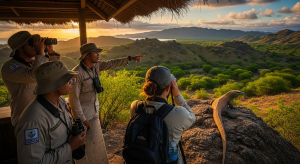
What Is the Best Time for Komodo Conservation Travel?
- Optimal Weather: The islands are lush and green following the rainy season, with dry, sunny days and excellent water visibility.
- Fewer Crowds: You arrive before the peak July-August tourist influx, allowing for more intimate wildlife encounters.
- Peak Conservation Activity: Conditions are perfect for coral reef monitoring and observing the highly active Komodo dragons.
The Editor’s Perspective: Timing Your Impact
The air is thick with salt and the scent of dry earth as our phinisi schooner, the Amandira, cuts through the turquoise water. On the port side, the volcanic contours of Padar Island rise like a sleeping giant, its savannah grasses still holding a hint of post-monsoon green. This is the Komodo National Park, a realm that feels both prehistoric and urgently contemporary. As a travel editor, I’ve sailed these waters many times, but my focus has shifted from pure leisure to purpose. The question I now ask—and the one our readers increasingly pose—is not just *how* to visit, but *when* to visit for the greatest positive impact. The answer is nuanced, a careful calculation of seasons, wildlife behavior, and the specific needs of the conservation initiatives on the ground. Determining the best time for Komodo conservation travel requires looking beyond the weather forecast and into the very ecological pulse of this UNESCO World Heritage Site. It’s about aligning your presence with the rhythm of the dragons, the coral, and the community.
The Shoulder Season Sweet Spot: April to June
For the discerning traveler focused on meaningful engagement, the months of April, May, and June represent the absolute pinnacle of opportunity. This period is what we in the industry refer to as the “perfect shoulder.” The heavy rains of the monsoon, which typically peak from January to March, have subsided, leaving the islands exceptionally verdant. The landscape, which can appear scorched and arid by September, is vibrant with life. Average daytime temperatures hover at a comfortable 30°C (86°F), and the seas are generally calm, making for serene sailing between the 29 islands that constitute the park. Critically, water visibility for diving and snorkeling is at its zenith, often exceeding 30 meters. This clarity is not just a boon for photographers; it’s essential for the marine conservation work that defines a definitive Komodo voluntourism experience. During these months, our partners on the ground focus heavily on coral reef monitoring and regeneration projects. The stable, clear water allows for precise data collection on coral bleaching and the success rates of newly planted coral fragments. On land, the Komodo dragons (Varanus komodoensis) are particularly active, energized after the wet season and frequently seen patrolling the beaches of Rinca and Komodo islands. You are also arriving ahead of the European summer holiday rush, which floods the park in July and August. Visitor numbers are perhaps 40-50% lower than in peak season, meaning a quieter, more profound connection with the environment you are here to protect.
Peak Season Dynamics: July and August
There is no denying the appeal of Komodo in July and August. This is the driest, sunniest part of the year, and it has long been marketed as the prime window for a visit. The trade winds, known locally as the southeast monsoon, provide a steady breeze that is ideal for sailing. However, this popularity comes with significant trade-offs that a conservation-minded traveler must consider. Labuan Bajo’s Komodo Airport (LBJ) is at its busiest, and the most popular anchorages can feel crowded. According to park management data, visitor numbers can swell to over 300,000 annually, with a large percentage concentrated in these two months. This influx places considerable strain on the park’s fragile ecosystem. As a protected area recognized for its “outstanding universal value,” the UNESCO World Heritage Centre has repeatedly flagged the challenges of managing this tourism pressure. From a conservation perspective, this period is defined by one major event: the Komodo dragon mating season. The powerful males engage in dramatic, often violent, ritual combat over females. Witnessing this is a rare privilege, but it requires expert guidance to ensure no human interference. Responsible operators, like those vetted for a komodo volun tourism itinerary, work closely with park rangers to manage viewing distances and group sizes, ensuring the dragons’ natural behaviors are not disturbed. While the weather is impeccable, be prepared for charter and accommodation prices to be 25-35% higher than in the shoulder season.
The Marine Focus: September to November
As the southeast monsoon wanes, the character of Komodo shifts once again. From September through November, the islands take on their iconic dry, savanna-like appearance. The lush green of April has faded to gold and brown, a starkly beautiful backdrop for the dragons. While the terrestrial landscape is arid, the marine world comes alive in a spectacular way. Water temperatures begin to drop slightly, from a balmy 28-29°C to a cooler 25-27°C, as nutrient-rich upwellings from the deep Indian Ocean flow into the park. This plankton bloom is a dinner bell for the ocean’s giants. This is, without question, the best time of year for encountering majestic reef manta rays (Mobula alfredi). Dive sites like Karang Makassar, often called “Manta Point,” become cleaning stations and feeding grounds for dozens of these creatures, whose wingspans can reach up to 5.5 meters. Conservation efforts during this window pivot heavily towards the marine sphere. Voluntourists often participate in manta ray identification projects, using underwater photography to capture the unique spot patterns on their ventral surfaces. This data is contributed to global databases, helping researchers track populations and migration patterns. Dr. Elitza Germanov, a leading researcher with the Marine Megafauna Foundation, has highlighted the importance of this citizen science in understanding these vulnerable animals. The cost of a trip during this period can be more accessible; for a detailed breakdown, our Komodo Voluntourism Pricing & Cost Guide offers invaluable insights.
Embracing the Wet Season: December to March
The conventional wisdom is to avoid Komodo during the wet season. From December to March, the northwest monsoon brings rain, higher humidity, and the potential for rougher seas. For the typical tourist, it’s not ideal. But for the dedicated conservation traveler, this period offers a unique and valuable perspective. The park is nearly devoid of other visitors, providing an sense of solitude and discovery. The rains transform the islands into a landscape of intense, almost incandescent, green. It’s a photographer’s dream. From a practical standpoint, this is when much of the “unseen” conservation work takes place. With marine conditions less predictable, efforts often shift to land-based projects: mangrove reforestation, terrestrial surveys, and community outreach programs in Labuan Bajo and the surrounding villages. This is also the nesting season for Komodo dragons. While you are unlikely to see the females laying their 20-30 eggs in their subterranean burrows, understanding this critical phase of their life cycle is a key part of the ecological education offered on conservation trips. According to official information from Indonesia’s Ministry of Tourism, the park remains open, but some boat operators may pause services during the peak of the rains in January and February. It’s a time for the intrepid, the flexible, and those who want to see the vital, less glamorous side of conservation in action.
Aligning Your Trip with Specific Conservation Goals
Ultimately, the best time for Komodo conservation travel is a personal equation, balancing your interests with the ecological calendar. The question should be less “When is the weather best?” and more “What impact do I want to have?” For the aspiring marine biologist, the September to November window, with its cooler, nutrient-rich waters and abundance of manta rays, is unmatched. Your time will be spent in the water, contributing to vital megafauna research. For the terrestrial ecologist fascinated by the dragons themselves, the April to June period offers sightings of active lizards in a vibrant, post-monsoon habitat. This is the time for tracking and behavioral observation. For those passionate about community development and cultural exchange, the “off-season” from December to March can be surprisingly rewarding. With fewer tourists, there are more opportunities for meaningful engagement with local communities on projects that support sustainable livelihoods beyond tourism. Planning a trip with this level of specificity is the hallmark of true conservation travel. It moves beyond a passive vacation and becomes an active contribution. When you are ready to translate your passion into action, you can book your Komodo Voluntourism journey and begin tailoring it to the season that best fits your purpose.
A Quick FAQ on Komodo Conservation Travel Timing
When is the absolute cheapest time for a Komodo trip? The lowest prices for charters and flights are typically found during the peak of the wet season, specifically in late January and February. However, you must be prepared for potential travel disruptions due to weather and accept that some marine activities may be limited. Is Komodo National Park ever fully closed? The park remains open year-round. That said, individual islands or dive sites may be temporarily restricted for ecological recovery or safety reasons, a decision made by the park authority (Balai Taman Nasional Komodo). Always travel with a licensed and informed operator. What is the best time for underwater photography? For clarity and vibrant coral, April to June is superb, with visibility often exceeding 30 meters. For dramatic encounters with large marine life like manta rays, September to November is prime, though the water may have more plankton, slightly reducing overall visibility but enhancing the “big animal” action. How far in advance should I book for a peak season conservation trip? For a specialized conservation-focused trip on a high-quality vessel in July or August, we strongly advise booking at least 10 to 12 months in advance. The best guides and vessels with genuine conservation credentials are in high demand and are often reserved a year or more out.
Choosing the right season is the first step in a journey that goes beyond tourism and enters the realm of stewardship. It’s about understanding that your presence has an impact, and timing it to ensure that impact is overwhelmingly positive. The Komodo archipelago is not a static postcard; it is a living, breathing ecosystem with its own rhythms and needs. By aligning your travel with this pulse, you become more than a visitor; you become a participant in its preservation. Explore what a true komodo volun tourism experience entails and find the perfect time to make your own contribution to this extraordinary place.